Pension Fund.
Pension Fund Solutions for Companies.
Companies need a solid and affordable pension fund solution to be attractive to qualified employees in the job market. The complexity of occupational pension provision increases year by year, and our goal as your broker is to enable you to concentrate on your core business thanks to our advice and support.
BVG Solutions for SMEs.
Choosing the right pension solution is a central point for many companies, especially when it comes to recruiting new employees. Within BVG insurance, you can choose between a full insurance, a partial and autonomous, or a 1e pension solution:
Full insurance:
Full insurance offers the greatest possible security, as all risks are borne by an insurance company.
(Partially) autonomous insurance:
With the (partially) autonomous BVG solution, an investment strategy, which is determined by the board of trustees within the legal framework, can be used to generate additional interest on retirement assets. The pension fund must pay the currently valid minimum interest rate of 1.25% (as of 2025) on the BVG capital.
1e pension solutions:
Offer management employees with higher incomes individual solutions in investment strategy, which can be co-determined. The pension solution can be individually adapted for each insured person.
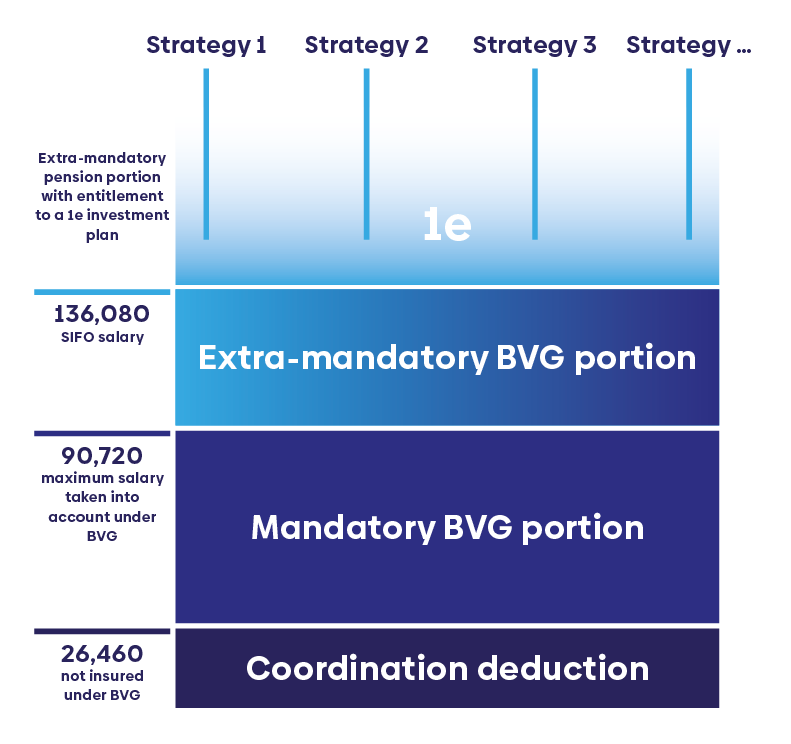
In principle, various BVG solution variants are possible:
BVG Standard:
For smaller companies or start-ups with few employees, standardized solutions are possible, which are more cost-effective.
BVG Individual with super-mandatory pension provision:
BVG Individual with super-mandatory pension provision:
Depending on the size of the company and the number of employees, an individual solution with different plans for respective employee groups can be defined in most cases.
The super-mandatory pension provision (management insurance) supplements the mandatory part of the BVG and offers special benefits, e.g., for management.

The following points must be considered when choosing a BVG solution:
Pension conversion rate.
The pension conversion rate is the value by which the available retirement capital is converted into a lifelong pension upon retirement. The legally prescribed minimum conversion rate for the mandatory retirement assets of the pension fund is currently 6.8% (as of 2025).
Swiss pension funds must pay out pensions according to BVG (Pillar 2) at the legally prescribed minimum conversion rate or higher. For the super-mandatory savings portion (Pillar 2b), there is no legally prescribed minimum, so the conversion rates vary greatly here and should be compared. The conversion rate for voluntary pension provision differs depending on the pension fund and pension plan.
Example: If you have accumulated 100,000 Swiss francs in retirement assets by retirement age, you will receive a pension of 6,800 Swiss francs per year on the mandatory assets.
Security of the foundation and coverage ratio.
The coverage ratio and its development are an indicator of the level of reserves and the security of a foundation.
Risk premiums, administration costs.
The cost factor is an essential element. Risk premiums are premiums paid for benefits in the event of invalidity or death of the insured person. Administration costs can also vary greatly from one pension fund to another. Therefore, we regularly compare and control these costs. As a rule, costs are borne 50% by the employer and 50% by the employees. Other contribution solutions are also possible in favor of employees, and the company may assume an increased share of the deductions.
Interest on retirement assets.
The Federal Council sets the minimum interest rate on BVG retirement assets. However, what is important for the individual insured person is the effectively granted interest rate of the pension funds on the respective savings assets. These super-mandatory interest distributions are surprisingly very different.
Frequently asked questions regarding pension funds (BVG):
Contact us.
We are happy to advise you.
 Activity:
 Activity: